







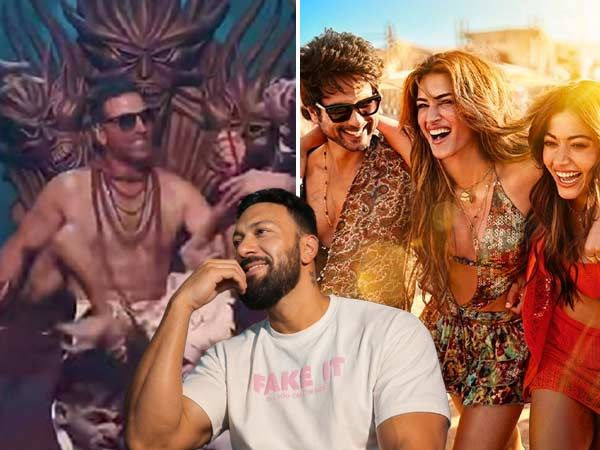

Behind every Bollywood song that becomes a hit, there’s a lot more happening than what audiences usually see. While singers are often in the spotlight, music producers play a huge role in shaping how a song finally sounds, from its structure and arrangements to its overall mood and energy.
One such name is Abhijit Vaghani, who has been working in Bollywood for over two decades. He has worked on films like Bajrangi Bhaijaan, Dhoom 3 and Yeh Jawaani Hai Deewani, apart from leading projects like Mixtape. He is currently in the news for Cocktail 2 and Ram Ji Aake Bhala Karenge from the recently released Bhooth Bangla.
In this exclusive conversation with Filmfare, Vaghani gives us a behind-the-scenes look at how Bollywood music is made today, how the role of music producers has evolved over the years, the rise of EDM and remix culture, the pressure of creating music for sequels like Cocktail 2 and how social media trends are changing the way songs are structured and consumed.
Excerpts:
Can you share an insight into your work in layman’s terms?
There are different categories in music, such as music direction, music production, sound engineer, and more. While the music director plays a huge role, they are essentially the one who creates the tune of the song. Let’s say there is a melody being hummed. It could already have lyrics, or even vocals by a singer. Sometimes, the music director hums the tune and gives us a brief about the situation or the mood of the song. From there, as music producers, we build on that melody and add music to it. That also requires composition through instruments. That’s essentially what the music producer does.
What did your role look like in Bhooth Bangla and Cocktail 2?
There’s a role of structuring a song properly. A big part of my contribution is sharing inputs on how a composition can sound better. Thankfully, today, those inputs are welcomed and valued much more. But when I had just started, things were very different. We were expected to sit in one corner and just make the music. The sound of
songs was different, the instruments used were different, and the entire musical landscape operated on another spectrum. Now, the soundscape has shifted more towards EDM influences. If I say the word remix today, it doesn’t surprise anyone because that style has become a big part of mainstream music.
But earlier, songs sounding like remixes had a certain shock value. People often looked down upon those arrangements. But as we started moving forward, people gradually began accepting those kinds of treatments in songs. Films like Dhurandhar, or even the song Jab Talak from Cocktail 2, are exploring completely new disco-inspired spaces with hardcore EDM basslines, and audiences genuinely want that sound today.
Do you feel that this job makes you feel invisible at times?
Within the industry, many people share this information with those who may not be aware. But I still get a lot of surprised reactions when I say I’ve produced a song. People assume I’ve invested money in the track. So, I often have to explain what a music producer actually does. Even if you look at Bhooth Bangla’s title track, it still uses terms like “music programmer” and “arranger.” These are older production houses that have continued using older terminology. I actually had a tough time introducing the title of “music producer” because the film producer would immediately say, “But I’ve produced the film.” I had to explain that I wasn’t stepping into his territory. This is music production, and the term comes from Western music culture.
But I also get appreciation and in regard to growth in work. And for those who still don’t understand the term, I keep educating them.
One of your recent tracks, Ram Ji Bhala Karenge, sparked a lot of comparisons with Satyajit Ray’s older composition. While working on this, were you aware of that similarity?
We usually don’t know the internal workings between producers, directors and music directors. But since I have the liberty to ask, I sometimes do. The thing is, people might think it’s a copy. However, most people are not aware of how folk tunes and traditional music rights work. There are different timelines under which folk music can be reused. Some fall under 30-year rules, some under 40-year or even 90-year scales. So, there are many possibilities there.
There are a lot of choices there. And as per the free domains of folk are concerned, if it says traditional lyrics on any link that you see, those are free to use. But there’s usually a condition attached. Sometimes you can only use the tune, sometimes only the lyrics.
You either create a new tune using the lyrics or write new lyrics using the original tune. All of that depends on tracing the ownership and licensing history. Maybe they had an arrangement to buy the licence. Maybe there were other agreements involved. I also noticed there were slight note changes in the Bhooth Bangla song. I wouldn’t be aware of the licensing because those are all internal deals which they have.
You have worked extensively with Pritam, one of India’s most celebrated composers. Tell me about that bond and how it has evolved over time.
A lot of that bond has been encouraged by Pritam. He has always been extremely experimental with his music. He loves hearing new sounds and experiencing songs differently from how he originally composed them. That’s why we create so many versions with him. Over the years, our bond has improved to the point where he simply sends me a song and says, “Do whatever you want and send it back.” So, my focus becomes understanding the brief and the situation of the song within the film.
But there’s also the lyrical aspect. For instance, if a song sounds dance-oriented but the lyrics are sad, then I instinctively know I need to slow the tempo down.
Sometimes, there are disagreements between Pritam and I but, they’re always healthy because we focus on the work more than personal preferences.
Coming to Cocktail 2, the album of Cocktail (2012) has aged beautifully. Is there pressure to live up to that legacy?
For Cocktail 2, I got a very simple brief: keep it modern. While working on the score, I had to make the music edgy and upbeat.
There will always be comparisons when it comes to sequels. People are already saying that Jab Talak carries Tumhi Ho Bandhu vibe. But at the same time, we have to also understand that comparing a film from 10 or 12 years ago to today’s soundscape isn’t entirely fair because everything changes. The dynamics change completely. Even story-wise, the situations are different. So, how can you recreate the same feeling? I can understand comparisons if it’s something like Dhurandhar 1 and 2, where the same family and continuity are involved. But Cocktail 1 and 2 feel like completely different families altogether. There are a lot of songs coming ahead, too, which are very different.
But is there still pressure to recreate that feeling of nostalgia?
Yes, absolutely. There’s definitely pressure to recreate that “hit album” feeling. The music director faces an even bigger challenge than the music producer because he has to ensure the entire album connects again.

That recall value can also come in through different techniques, like bringing older songs into the background score or using familiar motifs. Those become emotional recall points for the audience. And even if recreations from the older film are involved, that becomes an even bigger challenge because you’re adding new words and newer production to something that is already a massive hit. Matching up to that, or trying to make it even better, is definitely difficult.
With social media and trends, if a song goes viral online, that itself becomes a marker of success now. Do you have to keep that aspect in mind while working on other songs?
Yes, we have to. I constantly study the market and review trends almost every week. But virality is temporary. If we get a chance to create something within that window, we do it. At the same time, the shrinking attention span has drastically changed song structures. Intro music has become shorter because people want vocals to come in faster. Musical pieces have reduced to almost half of what they used to be. Verses can’t go beyond four lines. The pre-chorus often has to repeat the same tune and words for stronger recall. And the hook line usually needs to arrive within the first 30 to 50 seconds.
I genuinely miss the days when I could create longer intros and elaborate musical pieces. But at the same time, this new format is challenging in an exciting way because now we have to create impact within a much shorter duration.
Do you think artists are also reaching a point of creative saturation? For example, someone like Arijit Singh stepping back from playback singing while continuing independent and classical music. What does that tell us about the industry?
That’s a very subjective thing. If we talk about Arijit, he has always been someone who does his own thing quietly. He’s always been grounded and focused on his work. So, I don’t think people should be surprised by his choices. Of course, he probably still has many previous commitments to fulfil, but maybe he’s also moving towards something he truly wants to pursue. And I think he’s in a position where he can make those decisions. So, it shouldn’t necessarily be seen as shocking.
As for artists reaching saturation points, that’s subjective, too. I feel many artists today are constantly creating but not listening enough. They’re not exploring different genres, structures or studying music deeply. If you don’t analyse the world around you and understand where your music stands compared to others, you’re naturally going to hit a creative block.
What next for you?
A new season of Mixtape is coming. This will be the sixth season. I also have a lot of live shows lined up because I recently started performing live. At the same time, I’m also trying to focus more on my singing. There are so many things I’m involved in right now that it becomes difficult to focus on just one thing.
Also Read: “Amari is all business”- Simone Ashley on her character in The Devil Wears Prada 2 – Exclusive